Technical résumé template
An engineer-focused résumé template that pulls skills and projects to the top.
Technical reorders the document so your stack and your projects appear before your employment history — the order most engineering reviewers actually read in.
Section headings are prefixed with a hash, a small nod to the audience without turning the page into a novelty.
Best for
- Software engineers
- Data and infrastructure roles
- Applicants whose projects outweigh their job titles
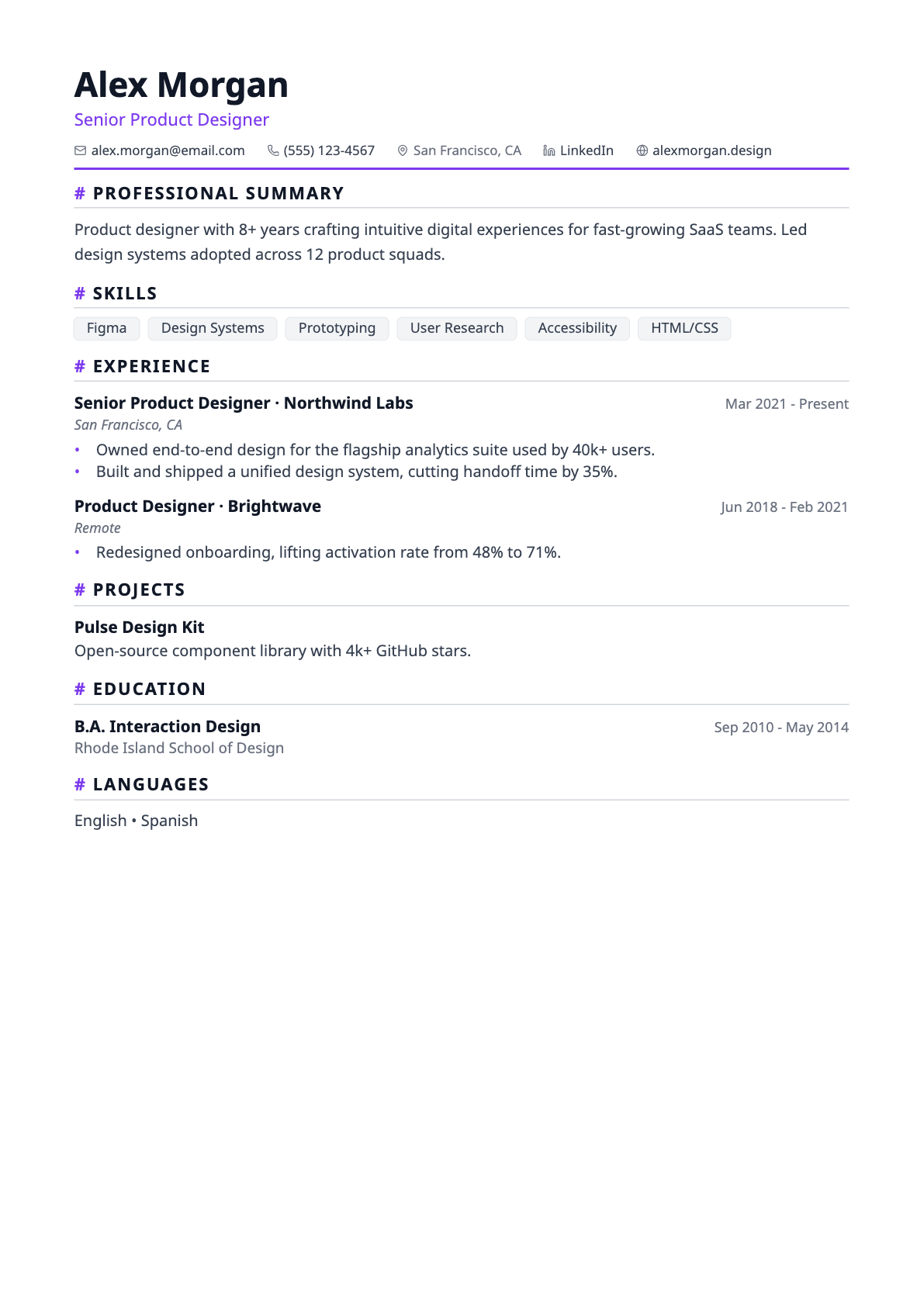
Template details
- Layout
- Single column, left-aligned header
- Section headings
- Hash prefix
- Skills
- Outlined tags
- Typeface
- Sans-serif (Noto Sans)
- Page size
- A4
- Exports
- PDF and DOCX
- Plan
- Free
Questions about the Technical template
How is Technical different from Tech Grid?
Both lead with skills. Technical then goes to experience, keeping projects third, and renders skills as outlined tags. Tech Grid puts projects second — directly after skills and ahead of experience — and gives repository and portfolio links their own line, so it suits applicants whose public work is the strongest evidence.
Is the Technical template ATS-friendly?
Yes. Text is drawn as real, selectable text rather than an image, so applicant tracking systems can parse it. Every template uses conventional section headings (Experience, Education, Skills) and exports to both PDF and DOCX, which are the two formats job applications normally accept. If you want the most conservative possible structure, the ATS-Max template is single column with no rules, tags or colour blocks at all.
Can I switch templates after I start writing?
Yes, at any time. The template is stored separately from your résumé content, so switching only changes the design — nothing is reordered, rewritten or lost. You can move between all templates from the builder toolbar and watch the page count update as you go.
Does it support non-English characters?
Yes. Latin, Greek, Cyrillic, Hebrew, Arabic and Chinese/Japanese/Korean text all render in both the on-screen preview and the exported PDF, with right-to-left scripts laid out in the correct direction.